
The Evolution of Obesity
Why Calories-In-Calories-Out Is Both True—and Deeply Misleading

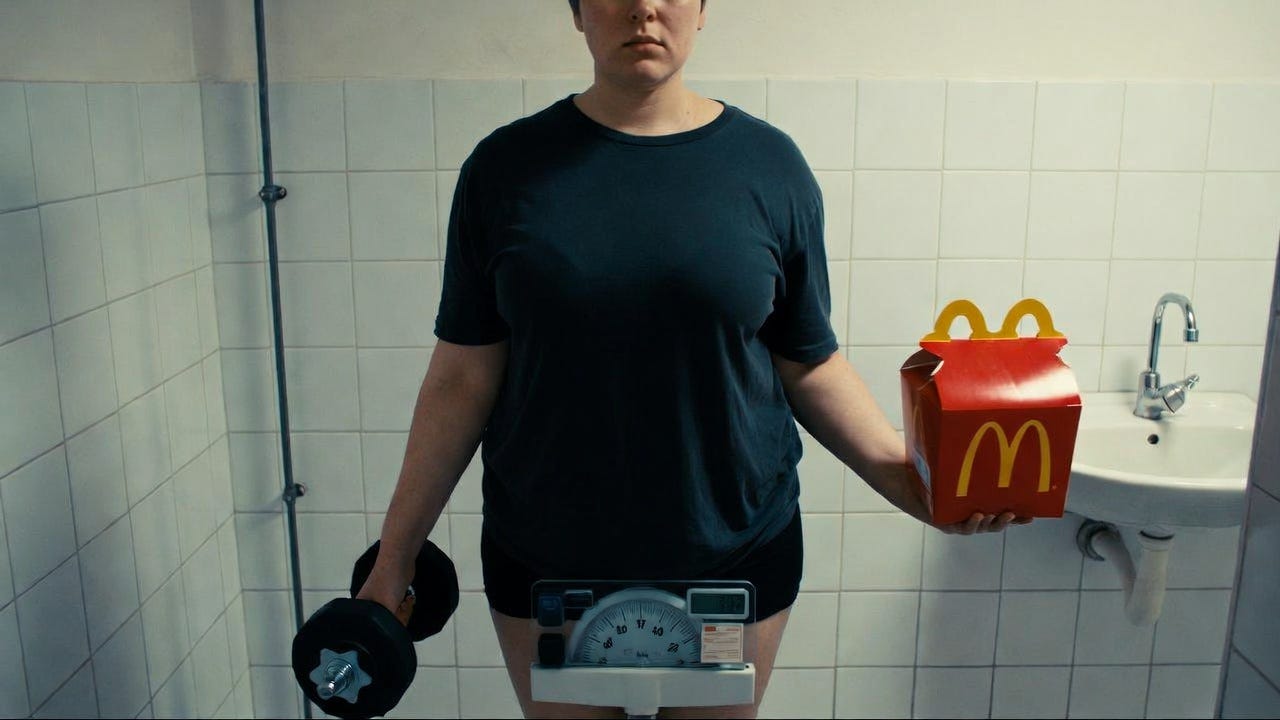
Calories-in-calories-out (CICO) has long been held as a “fundamental truth of weight loss." That said, it is incredibly difficult; people fail at it pretty regularly for a number of reasons, primary among them being that calorie restriction feels like starvation (because, well, it is starvation).
Calorie restriction increases hunger.
It raises stress.
It drives cravings.
It slows metabolism.
It makes you think about food constantly.
It reduces spontaneous movement.
It makes the body cling to fat.
There are many reasons people struggle with CICO but one major reason people find it difficult is because it requires overriding instinct. It requires doing something none of our ancestors ever had to do: Intentionally starve themselves. Like standing at the highdiving board and trying to command yourself to jump; sure, you can do it but it isn’t easy.
And, when the calorie restriction period ends – generally much sonner than we intended – the any weight released generally comes back and often faster than before and more than before.
Anyone who has ever tried to “eat less and move more” knows this pattern.
Now — perhaps if CICO were merely difficult but fundamentally correct, all of this suffering might be worth it. We could inspire people to grit their teeth, override biology, and push through the discomfort.
But the harsh truth is this:
It isn’t just a difficult strategy; it is a deeply flawed and often counterproductive one.
Strictly speaking calories-in-calories-out (CICO) is true.
And it is a terrible system for understanding obesity.
Both statements can be correct at the same time when you understand the real math of CICO.
CICO as Enron Accounting
At the level of physics, CICO must be true.
Energy cannot be created or destroyed. If a human consumes less energy than they expend for long enough, body mass will decrease. If they consume more than they expend, body mass will increase.
Physics is not wrong.
To start, obesity is not a basic physics problem.
It is a complex biology problem.
And biology evolved.
And understanding that shows us that he CICO math is way off.
Enron off.
If you looked only at Enron’s revenue and expenses in isolation, the numbers appeared solid. Revenue was strong. Costs were managed. On paper, everything balanced.
But what those clean spreadsheets concealed were:
Off-balance-sheet entities
Hidden liabilities
Distorted incentives
Internal financial engineering
Structural fragility disguised as strength
From a narrow accounting perspective, Enron “worked.”
Until it didn’t.
CICO operates the same way.
It focuses on:
Energy in.
Energy out.
Net change.
CICO pretends the body is a closed system with complete accounting.
But it ignores the internal mechanics of how energy is managed, stored, conserved, redirected, or even discarded.
It treats the human body like a static ledger.
But the human body is not a ledger.
It is a dynamic, adaptive energy management system shaped by millions of years of scarcity.
CICO isn’t wrong.
It’s incomplete.
And incomplete models fail in predictable ways.
The Evolution of Energy Management
For nearly all of human history, food scarcity was the primary threat to survival.
Winter came.
Drought came.
Game migrated.
Fruit disappeared.
Those who could store energy survived.
Those who could not, died.
So we evolved not merely a calorie-burning system — but a calorie-storing and calorie-conserving system.
We evolved:
Insulin-driven fat storage in times of carbohydrate abundance
Fat-burning mechanisms in times of carbohydrate scarcity
Increased hunger during energy deficit
Reduced metabolic rate during famine
“Thrifty” adaptations when survival feels threatened
Fat storage is not a malfunction.
It is a survival advantage.
Obesity, in evolutionary terms, is not a design flaw.
It is an out-of-balance survival system operating in an environment of permanent abundance.
Obesity is a classic symptom of evolutionary mismatch; an evolution gap.
The Math Is More Complicated Than the Slogan
Let’s examine the CICO equation more closely:
Energy In – Energy Out = Change in Body Mass
Simple.
Except “Energy Out” is not fixed.
To truly calculate energy expenditure, we would need to account for:
Basal metabolic rate (which adapts downward during restriction)
Thermic effect of food (different for protein, fat, carbohydrate)
Non-exercise activity thermogenesis (NEAT)
Hormonal shifts (leptin, ghrelin, insulin, cortisol)
Thyroid regulation
Adaptive thermogenesis
Brown fat activation
Immune activity
Reproductive suppression
Digestive efficiency
Microbiome energy extraction
Heat loss
Tissue repair costs
Inflammatory burden
Caloric loss in feces
Caloric loss in urine
Even urinary glucose loss varies depending on insulin sensitivity. (But now many CICO advocates even mention this in their math?)
This is not a new observation.
One of the earliest recognizable descriptions of diabetes comes from ancient India, where physicians used the term madhumeha — “honey urine.” They observed that the urine of affected individuals could be sweet and sticky… and famously, that it could attract ants.
That’s not trivia.
It’s a reminder that the body doesn’t simply “burn” calories — it routes them. Under certain metabolic conditions, it can literally spill usable energy out through the kidneys.
Try fitting that into a neat CICO spreadsheet.
The human organism is not a static furnace.
It is adaptive.
When intake drops, output often drops too.
That is not a violation of thermodynamics.
It is thermodynamics expressed through biology and at a level of sophistication that even the most creative accountant would struggle to understand.
Winter and Spring: Metabolic Modes
Imagine two companies, each generating $1,000,000 in annual revenue.
One sees storm clouds gathering.
Winter is coming.
It cuts costs.
Negotiates harder.
Reduces spending.
Increases reserves.
Becomes conservative.
The other sees economic expansion ahead.
Spring is here.
It invests.
Spends freely.
Expands.
Releases reserves.
Same revenue.
Different behavior.
The human body works the same way.
Calories alone do not determine fat loss.
Perceived environment does.
When calories are chronically restricted, the body interprets the signal.
If it senses famine, it becomes thrifty:
Metabolic rate declines
Thyroid output shifts
Hunger increases
Non-essential processes are reduced
Fat becomes harder to release
And if someone is simultaneously consuming refined carbohydrates during calorie restriction — foods that stimulate insulin and appetite — they are attempting to override hunger while actively stimulating it.
That is not a willpower problem.
It is a signaling problem.
So Is CICO Wrong?
No.
In an absolute sense, CICO is true. But that truth is impractical both because CICO requires incredible will power and because the math is, as we have discussed, deeply flawed and incomplete.
Further, CICO ignores:
Metabolic modes
Hormonal signaling
Adaptive thrift
Evolutionary context
Psychological cost
CICO is flawed accounting.
And Obesity is and evolved strategy.
And here is the deeper truth:
You can bully your body into losing weight; you can starve yourself, suffer through it, damage your metabolism and destroy your quality of life all so that you can put the weight back on when your willpower runs out.
Our, you can eat and live in a way that makes your body feel safe to release weight.
For most of human history, fat loss did not occur because our ancestors starved themselves intentionally.
It occurred because the environment shifted.
Carbohydrates disappeared.
Food became seasonal.
Insulin fell.
Glucagon rose.
Fat-burning pathways activated.
The body moved from autumn to winter mode.
That is metabolic flexibility.
The ability to move between storing and burning.
The problem today is not that we eat too much.
The problem is that most people are metabolically stuck in perpetual late summer — constant carbohydrate exposure, constant insulin signaling, constant storage.
Then we attempt to create fat loss not by changing metabolic signals, but by creating artificial famine.
The body resists.
And rightly so.
If winter truly were coming, thrift would save your life.
The key to sustainable weight loss is not starvation.
It is restoring metabolic flexibility.
It is feeding yourself in a way that lowers storage signals, stabilizes appetite, reduces stress, and allows your body to feel secure enough to release what it no longer needs.
When the body feels safe, it becomes generous.
When it feels threatened, it becomes conservative.
That is not a character flaw.
That is evolution.
Physics balances the ledger.
Evolution determines the behavior.
And safety determines whether the body spends — or saves.
Great article Eric. I really appreciate this framing.
You’re absolutely right that we were never meant to live in chronic artificial famine. The body resisting is not a moral failure. It’s adaptive biology doing what it was designed to do.
I would just gently add one evolutionary layer to the discussion.
We didn’t just evolve in environments of variable food availability. We evolved in environments of extremely high daily energy flux. Constant movement. Manual labor. Walking. Lifting. Carrying. Repeated muscular contraction from dawn to dusk.
Metabolic flexibility did not evolve in low-output conditions.
It evolved in systems where energy turnover was high.
If physical demand drops below the level our physiology was built for, metabolic buffering capacity declines. Insulin sensitivity falls. Storage signals become chronically elevated even at normal intakes. The same food becomes more fattening because the metabolic machinery isn’t being turned over.
In that context, food restriction becomes a compensatory strategy rather than a root solution.
So I completely agree that famine is not the answer.
But unless we restore something closer to ancestral levels of energy flux, we may never fully restore the flexibility we’re aiming for.
It may not be just about eating differently.
It may be about living differently
This is presented is a very clear, easy to understand format. Kudos on that! I was never overweight. My favorite plate at Thankgiving dinner - the skin. I ate pretty much whatever I want. Interestingly enough, I only want whole, real food. At times, I do eat edible-food-like substances, but find them unappealing. During peri-menopause, I did develop quite the sugar craving...I undesrtood what a lot of people go through their whole life. The "food-noise"...or rather the "sugar-noise" was deafening. If there is a tub of icer cream in my freezer, I would think about it the whole time, until I eat it all. What a ride! Yup..cravings and hunger will win. Every time. I have so much emphathy for people who struggle with food addiction. That is a HARD way to live.